
Most ecommerce stacks were built for humans scrolling on phones, not for agents that buy on our behalf. As product feeds, payments, and logistics become machine mediated, the brands that win will be the ones that quietly become legible to AI.
In this article, I walk through how I think about structured data for AI agents, composable commerce, and agent-friendly APIs, and how to turn your current setup into a practical, agent-ready architecture rather than a science project.
Summary / Quick Answer
If you want your brand to show up in an agent-driven buying journey, you need to become understandable and reliable to machines. That means three things working together: structured data that AI agents can trust, composable commerce behind the scenes, and clean, agent-friendly APIs on the edge.
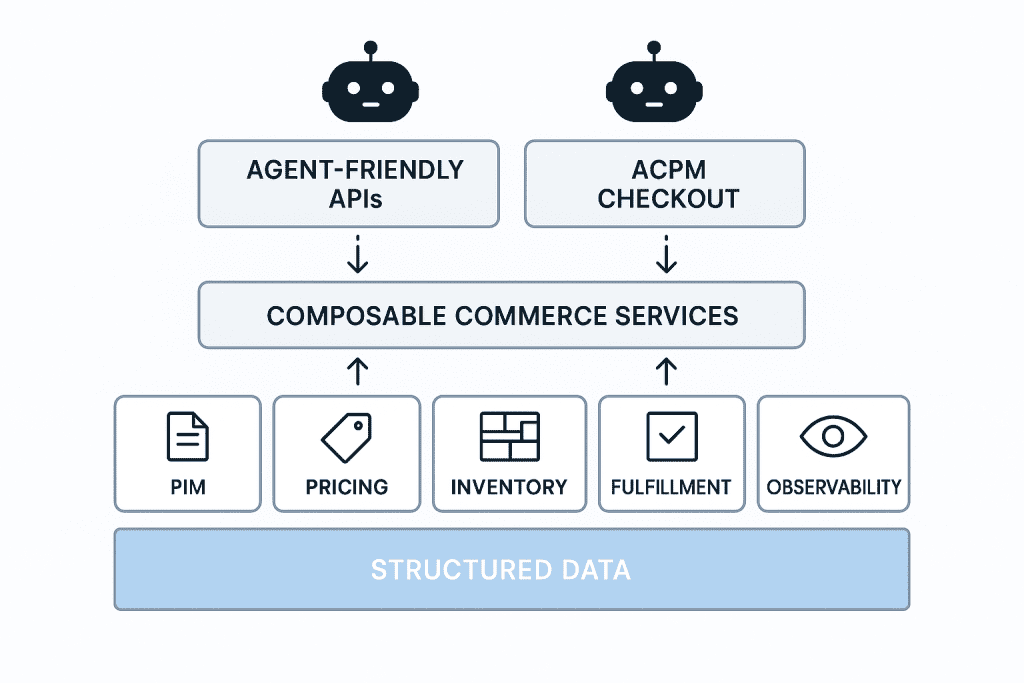
In practical terms, an agent ready infrastructure gives agents a real time view of product variants, prices, and inventory, exposes a small set of predictable checkout and status endpoints, and plugs into open standards such as Model Context Protocol and the Agentic Commerce Protocol. It also includes strong identity, delegated payments, and observability so you can see what your agents did and why.
Think of it as SEO, analytics, and payments, all upgraded for a world where your next best customer might be a bot buying for a person.
Why Structured Data For AI Agents Is The New SEO
The biggest mindset shift is this: your storefront is no longer the homepage, it is your product data. Agents never see your beautiful banner. They see JSON.
When I audit brands for agent readiness, structured product data is usually the weakest link. Descriptions are unstructured, variants are tangled, and availability is scattered across systems. In an agent world, that is like serving Google a blank page.
Modern agentic commerce guides, from Mirakl’s data discipline work to OpenAI’s own Agentic Commerce documentation, all converge on the same foundation.
You need machine readable product data, ideally exposed as JSON LD with Schema.org vocabularies, and you need it at the variant level, not just the parent product. If I ask an agent for “a blue, size 40 sneaker, available for delivery this week,” it must query variant documents with attributes like color, size, lead time, and current stock.
I treat this as “SEO for agents.” Instead of title tags and H1s, you focus on:
| Layer | What it holds | Why agents care |
|---|---|---|
| Identity | GTIN, MPN, EAN, internal IDs | Cross marketplace matching and deduplication |
| Variant attributes | Size, color, material, energy rating | Precise filtering and compatibility checks |
| Availability | Stock by location, lead times, cut offs | Trustworthy promise keeping for delivery |
| Rich content | Alt text, video descriptions, usage context | Better ranking for nuanced, preference based tasks |
If you want a deeper dive into how to structure your catalog for this world, I have a dedicated breakdown on product data set up for agents. The short version is simple. If an agent cannot answer “what is this, is it available, and is it a good fit for my user” from your data alone, it will move on to someone else.
Designing Agent Friendly APIs With An API First Mindset
Once the data is clean, the next failure point is usually the API surface. Most retail APIs were written for frontends controlled by the same engineering team. They assume predictable flows, short sessions, and a human in the loop. Agents do not work like that.
Agent friendly APIs need to be discoverable, predictable, and safe to call repeatedly. This is where protocols such as the Model Context Protocol (MCP) and the Agentic Commerce Protocol (ACP) come in.
MCP lets agents discover what tools your system exposes, understand input schemas, and adapt plans on the fly. ACP, originally proposed by Stripe and OpenAI, standardizes how product feeds, checkout sessions, and delegated payments are exchanged across agents, merchants, and payment providers.
In practice, I look for three characteristics in these APIs.
| Aspect | Legacy pattern | Agent friendly pattern |
|---|---|---|
| Request design | Many bespoke endpoints per use case | Small, reusable primitives such as checkout_sessions |
| Safety | Stateless retries without idempotency | Idempotency keys on write operations |
| Auth and identity | Long lived secrets in the client | OAuth scopes, short lived tokens, delegated payments |
For example, ACP expects endpoints such as POST /checkout_sessions, PATCH /checkout_sessions/{id}, and POST /checkout_sessions/{id}/complete. Paired with delegated payment specs, agents never see raw card data.
They pass constrained tokens that a PSP can charge once, within a defined amount and time window. Visa’s work on network tokenization and “intelligent commerce for agents” is moving in the same direction.
If you want to explore how these protocols fit together in more depth, I unpack the patterns in my primer on agentic protocols for commerce. The key shift is this.
Stop thinking about “an API for the website” and start thinking about “a small, opinionated set of APIs that any compliant agent can call safely, at scale.”
Composable Commerce As The Operating System For Agents
Most marketers have heard the term composable commerce. In an agent context, composability stops being a buzzword and becomes survival. Agents do not need one monolith that knows everything. They need a set of focused services they can orchestrate.
When I map an agent ready stack, I usually end up with a simple mental diagram. PIM handles product truth, a pricing service calculates context aware prices, inventory services track stock by channel, fulfillment routes orders, and content services store copy and media. Each one exposes stable, API first interfaces that an orchestration layer or MCP server can wire together.
Think of it like this.
| Service | Core responsibility | What the agent asks it for |
|---|---|---|
| PIM | Product and variant attributes | “What is this item and what are its constraints?” |
| Pricing | Discounts and dynamic pricing | “What should this user pay right now?” |
| Inventory | Stock and reservations | “Can I actually ship this, from where, and when?” |
| Fulfillment | Shipping options and routing | “What options match the user’s delivery needs?” |
| Content | Descriptions, images, rich media | “What should I show or summarise to my user?” |
This is where composable commerce and agentic commerce meet. Protocols such as ACP care about the transaction and payment flow.
MCP-style middleware cares about connecting specific tools to agents. Composable architecture gives both of them something clean to connect to.
If your current setup is a single platform that “does everything,” your first step is usually to separate concerns, not replace it. Start by extracting product truth into a proper PIM or headless CMS. I walk through concrete options in the article on product data for agents and humans. Then harden the boundaries for pricing, inventory, and fulfillment. Agents love clear contracts much more than they love clever monoliths.
Real Time Inventory And Pricing Feeds That Agents Can Trust
Here is the uncomfortable part. Your product page can lie to a human and you may get away with it. “Ships in 2 to 4 days” is fuzzy. A person tolerates it. Agents will not.
Agents rely on feeds and APIs that reflect inventory and pricing close to real time. If your stock sync runs every six hours, an AI shopper can easily drive overselling, cancellations, and support tickets. You are effectively asking it to steer a car while looking in the rear view mirror.
The brands I see moving fastest here treat inventory and price as streaming data, not nightly batches. They expose inventory management APIs that update stock the moment an order is created or returned, and they propagate those updates via webhooks to all channels, including agent facing ones.
Services such as API aggregators and specialized inventory platforms have been talking about this for years. Agent commerce simply raises the stakes.
A simple reliability checklist I use looks like this.
- Every stock change emits an event within seconds
- Webhooks are signed, idempotent, and retried with backoff
- Search indexes work on variants, not just parent products
- Pricing APIs support contextual queries, not just static lists
If an agent cannot trust your availability and price, it will either overcompensate with conservative assumptions or avoid you entirely. From a strategy point of view, this is one of the most cost effective upgrades you can make, because it improves both human and agent experiences in one move.
When you design these feeds, reuse the same structured product schema you prepared earlier and keep channel specific tweaks at the edge.
That way, whether the consumer is your storefront, a marketplace, or a shopping agent, they are always reading from the same underlying truth.
An Integration Roadmap To Build Agent Ready Infrastructure
At this point, the natural question I get from founders is, “Where do I actually start?” Nobody has the budget or appetite to rebuild their entire stack just to satisfy theoretical agents.
The answer is to sequence the work based on risk and opportunity. You do not need everything on day one. You do need a plan.
A simple roadmap I use with clients looks like this.
| Stage | Focus | Typical owner |
|---|---|---|
| 1. Data hygiene | Clean, structured product and variant data | Product, merchandising, SEO |
| 2. API surfacing | Solid, documented internal APIs | Engineering |
| 3. Agent endpoints | ACP style checkout and status endpoints | Engineering, payments, legal |
| 4. Observability | Logging, tracing, and evaluation | Data, platform |
| 5. Expansion | New use cases and new agent partners | Growth, partnerships, product |
In parallel, you should think in terms of B2A, not just B2C. Your buyer might be a person, but your first “channel partner” could be a shopping agent that sends you qualified orders.
I outline this more strategically in The Complete Guide to B2A Commerce [Business to Agents]: Preparing Your Ecom Brand for the AI-First Era, which dives into market positioning and partner selection.
From a technical perspective, I like to pick one narrow, high-value use case as a pilot. For example, “agent assisted checkout for repeat customers in a single market using ACP.” You standardize product data, wire in delegated payments using something such as Stripe’s shared payment tokens, and wrap it all in good observability.
Platforms like AWS Bedrock AgentCore and Azure’s agent frameworks already highlight how important evaluation and tracing are for production agents.
Once that pilot works, you can expand horizontally into new categories, markets, or agents.
It is much easier to sell this roadmap internally when you can point to one real use case that drives incremental revenue, not just theory.
Q&A: Common Questions On Agent Ready Commerce
Q: What is the difference between a regular ecommerce API and an agent friendly API?
A: A regular API assumes a single frontend and human-controlled flows. An agent-friendly API is simpler, more predictable, and designed for autonomous tools that may call it frequently and in parallel. It uses idempotency, clear error codes, and small sets of standard endpoints such as checkout sessions instead of dozens of custom flows.
Q: Do smaller brands really need structured data for AI agents already?
A: If you are selling in competitive categories, yes. Even if agents are not a big traffic source yet, the work you put into structured data improves search, marketplaces, and internal tools. Think of it as future proofed SEO plus better internal analytics, not a separate project.
Q: What is the minimum I should do in the next twelve months?
A: Start with your product and inventory truth. Get variant level structured data in order, standardize how price and stock are exposed, and document your core APIs. From there, add a basic ACP compatible checkout flow and observability. You can always layer on advanced agents later, but without those foundations they will never pick you in the first place.
Conclusion
We are heading into a world where your next best customer might never see your homepage. Their agent will scan your structured data, call a handful of APIs, run a risk check, and quietly place an order if you look reliable.
Building an agent-ready infrastructure is not about chasing every trend. It is about doing a few fundamentals very well. Make your product data understandable, your commerce stack composable, your APIs predictable, and your payments and identity safe. Observe what your agents do, tune from there, and expand into new B2A channels as they prove themselves.
If you want to go deeper on the catalog side, start with the article on product data for agents and humans. For protocol-level thinking and concrete examples, the guide on agentic commerce protocols in practice is a good next stop.
The brands that treat this as a strategic capability, not a side project, will be the ones agents quietly prefer in the years ahead.
Quick Knowledge Check
Question 1: What is the most important foundation for agent ready commerce?
Question 2: What is a sensible first step toward building agent ready infrastructure?
