
Most ecommerce APIs were designed for people clicking through a storefront, not for agents negotiating and executing on their behalf. That gap is now visible in broken carts, stock conflicts, and failed automations.
To compete, you need to rethink agent API requirements within an API-first ecommerce strategy, especially how your middleware architecture supports agents. In this article, I will walk through the practical patterns I use with brands that want their stack ready for business-to-agent commerce, not just human traffic.
Summary / Quick Answer
If you want your brand to be “agent-ready,” treat your APIs as a product, not plumbing. Agent API requirements in an API first ecommerce stack start with a clear contract, real time data, and strong validation. Agents need streaming interfaces for conversation and inventory, clean middleware architecture for agents that hides legacy complexity, and predictable error handling.
In practice, this means combining REST for control with WebSockets or similar streaming for real time updates, plus GraphQL for inventory queries. The middleware and agent control layer should normalize data, map capabilities to MCP or ACP-style protocols, and enforce rate limits and policies. Underneath, you need event-driven inventory, a cache like Redis, and consistent testing and observability. Get those foundations right, and your agents can safely search, decide, and execute without wrecking customer experience.
Agent API Requirements in an API First E-Commerce Stack
The biggest mindset shift is this: agents do not “figure it out” from messy APIs. They rely on structure and consistency. In my experience, when teams skip that, they end up debugging ghost errors at 2 a.m.
At a minimum, an API first ecommerce stack that serves agents should give:
- A stable, versioned contract
- Strong validation and explicit error shapes
- Real-time signals around inventory and order state
- Idempotent operations for carts, holds, and payments
If your backend foundation is still evolving, it is worth reading how I think about an infrastructure stack built for agents. That article goes deeper into base layers like networking, auth, and event streaming.
Here is how I frame the core requirements when I audit an existing API surface.
| Requirement | What it means for agents | Risk if missing |
|---|---|---|
| Explicit schema | Strongly typed fields, enums, constraints, clear error codes | Agents misinterpret fields and retry blindly |
| Idempotent writes | Same call can be safely repeated without double charging or double hold | Duplicate orders, inventory oversell |
| Real time surfaces | WebSockets or similar for streaming stock and order events | Agents act on stale data |
| Deterministic responses | No hidden randomness or side effects on reads | Impossible to build reliable strategies |
| Rate limit transparency | Clear headers, retry hints, and quotas | Agents thrash, hit walls, then back off entirely |
According to a detailed walkthrough on deploying agents as APIs from Decoding AI, streaming responses cut perceived latency and align better with conversational flows than classic request response patterns alone, especially for multi step reasoning tasks where agents think “out loud” while the user waits (Decoding AI).
This is where API design principles, data validation, and protocol choice blend together. Get the contracts tight and you set agents up to behave like trustworthy power users instead of random script kiddies hitting your backend.
Designing Middleware Architecture for Agents, ACP, and MCP
Most teams try to plug agents directly into their monolith or headless platform first. It usually works for a demo, then collapses under real usage. You end up with 12 different integrations, each with its own understanding of “product,” “availability,” and “price.”
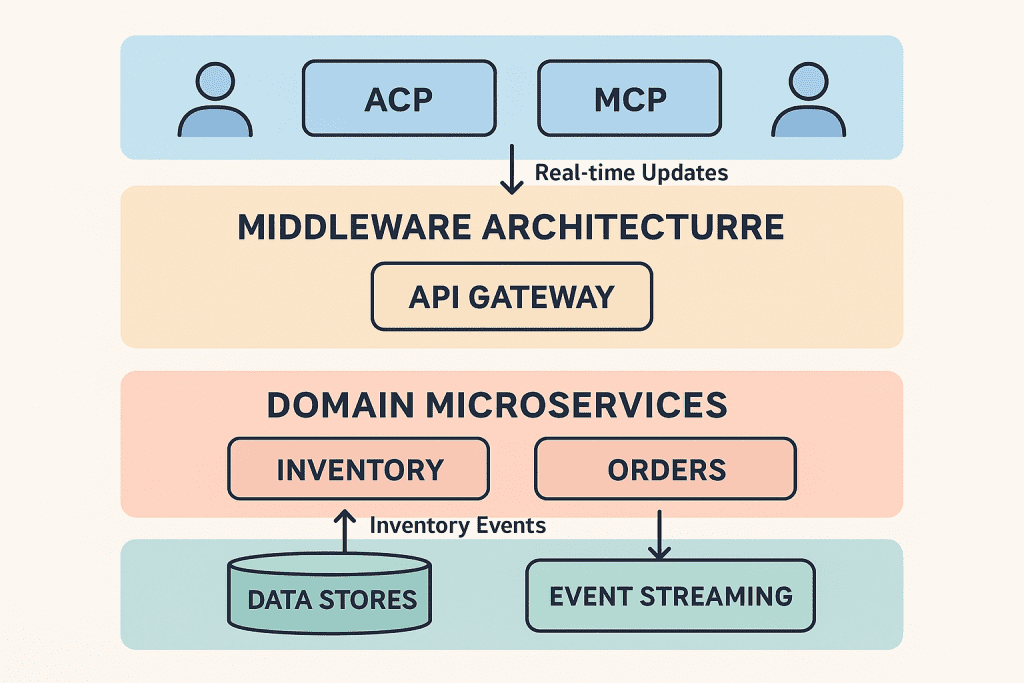
That is why I push for a deliberate middleware architecture for agents. Think of it as an “agent aware backbone” sitting between your existing systems and any ACP or MCP style control plane.
A practical layout I use looks like this.
| Layer | Role for agents | Notes |
|---|---|---|
| API Gateway | Auth, rate limits, routing, protocol handling | Often terminates TLS and WebSockets |
| Agent Middleware / Orchestrator | Normalizes schemas, applies policies, aggregates across systems | Ideal place to integrate ACP or MCP |
| Domain microservices | Inventory, pricing, catalog, orders | Own truth and business logic |
| External agent platforms | ACPs, MCP connectors, partner agents | Consume curated, stable APIs |
Modern gateways described by Gravitee and similar vendors increasingly handle both REST and streaming protocols, plus advanced auth and observability in one place (Gravitee).
Inside the middleware, you connect to an Agent Control Plane (ACP) that decides which agent or tool handles a request and a Model Context Protocol style layer that exposes tools and data sources in a predictable schema. This is where you expose:
- “Safe” tools for agents
- Clean inventory and pricing read models
- Guardrails and business rules
When you start thinking about business to agent flows, your middleware becomes the foundation. I explore the strategy side of that shift in more detail in The Complete Guide to B2A Commerce [Business to Agents]: Preparing Your Ecom Brand for the AI-First Era.
Of course, middleware does not remove complexity, it concentrates it. If you skip risk management here, the problems show up later as outages and angry customers. I outlined some of those pitfalls in my breakdown of challenges in agent driven commerce.
Real Time Inventory, Validation, and Event Driven Data Flows
Inventory is where weak API design hurts the most. Agents will happily place 1,000 orders on stock that disappeared 30 seconds ago if your system does not tell them otherwise.
The pattern I see working best is event-driven inventory, backed by a fast cache and a relational source of truth. Redis has a great example of this in their real time inventory guides, where in memory data structures and geospatial indexes keep response times under a millisecond for stock lookups across many locations (Redis real time inventory, Redis local inventory search).
On top of that, I usually recommend this protocol mix for agent traffic.
| Use case | Best fit | Why it works |
|---|---|---|
| Inventory search and filters | GraphQL | Agents request exactly the fields and locations they need |
| Streaming inventory updates | WebSockets | Push changes instantly, avoid polling |
| Internal microservice coordination | gRPC over HTTP/2 | Low latency service to service calls |
| Rare, simple operations | REST | Easy to cache and integrate, stable contract |
BigCommerce shows how GraphQL queries can target inventory at specific locations without over fetching (BigCommerce GraphQL inventory). Shopify’s GraphQL Admin API does something similar through its InventoryItem object and related mutations (Shopify InventoryItem).
From a validation perspective, I want every inventory touch wrapped in:
- Strict schemas at the edge and in events
- Soft reservations with short expirations
- Clear error categories, for example “out_of_stock,” “validation_error,” “rate_limited”
Event streaming matters too. Many teams pick between Kafka and RabbitMQ without a clear mental model. Kafka style platforms shine when you care about high throughput and replayable logs. RabbitMQ, as Quix explains, gives more nuanced routing and can be a simpler operationally for smaller teams (Kafka vs RabbitMQ).
For agents, I care less about the brand and more about these guarantees:
- Inventory events reach the cache quickly
- Events are typed and versioned
- You can rebuild read models if something breaks
If you are struggling with oversell, phantom stock, or race conditions, it is worth mapping your current flows against this kind of event-driven model. You will probably see where your architecture is fighting your goals.
To connect this back to earlier foundations, your inventory events and read models should feed directly into the agent ready infrastructure stack you are already building.
Scaling, Observability, and Reliability for Agent Commerce
Your first integration might be a single agent talking to a staging store. That is cute. The real test comes when partner agents, marketplaces, and your own apps all hit the same stack at once.
Scalability for agent commerce is not just “add more pods.” It is about staying reliable when traffic is unpredictable and conversational. Kubernetes is still my go to base for that. The official docs show how Deployments and Horizontal Pod Autoscalers let you scale microservices like inventory or cart independently, based on CPU, latency, or custom metrics (Kubernetes Deployments).
For reliability patterns, I borrow from the resilience engineering world:
- Retries with backoff and jitter for transient errors
- Circuit breakers around fragile downstream services
- Timeouts on every network call, not just at the gateway
- Fallbacks to cached or approximate data where safe
When you combine these with agent traffic, it looks like this in practice.
| Pattern | Agent scenario | Desired outcome |
|---|---|---|
| Retry with backoff | Short network blip while agent reserves inventory | Reservation succeeds without user noticing |
| Circuit breaker | Third party tax API slowing everything down | Agent gets cached tax estimate instead of error |
| Timeout | Slow warehouse system query | Agent switches to backup route or delays order |
| Fallback | Observability tool temporarily offline | Core commerce still runs, alerts recreated later |
Security belongs here too. Many agent integrations will use OAuth 2.0 for delegated access, plus JWTs for stateless auth between components. Google’s documentation on OAuth flows is still a solid reference for designing these flows correctly for user consent and token exchange (Google OAuth 2.0). For a practical guide to JWT and modern API auth patterns, I like the overview from WorkOS (API auth guide).
On the monitoring side, you can not improve what you can not see. Distributed tracing tools such as SigNoz, Jaeger, or other open source stacks help you follow a single agent call across gateway, middleware, inventory, and payments (Distributed tracing tools). That matters when a partner tells you “your API is slow,” but metrics on your side look fine.
When I design these stacks, I also think about future failure modes from the start. Many of the hardest problems I call out in my article on commerce challenges with agents are operational, not purely technical. The more volume you push to agents, the more they will probe every edge case in your architecture.
Q&A
Q: What are the core agent API requirements for an ecommerce brand?
A: You need a clear, versioned API contract, real-time access to inventory and order state, and strong validation on every write. Add streaming interfaces such as WebSockets, where agents must react quickly, and idempotent operations for carts and payments. Wrap everything in predictable rate limits and error shapes so agents can adapt rather than guess.
Q: How does middleware architecture help agents in an API first ecommerce stack?
A: Middleware centralizes complexity. It hides legacy systems, normalizes schemas, and exposes a clean set of tools to ACP or MCP style platforms. That makes it easier to enforce policies, route traffic across services, and introduce new capabilities without breaking existing agents. It also gives you a single place to implement logging, monitoring, and governance.
Q: Why is event driven inventory so important for agent based commerce?
A: Agents act quickly and at scale. If your inventory is only updated in batches or through slow queries, they will make bad decisions. Event-driven inventory broadcasts stock changes immediately, updates caches like Redis in real time, and gives agents a reliable picture of what is actually available. That reduces oversell, cancelled orders, and poor customer experiences.
Conclusion
APIs that were “good enough” for web and mobile traffic are not enough for agent-driven commerce. The brands that win here treat agent API requirements as a strategic topic, not an afterthought. They design API first ecommerce stacks with clear contracts, robust middleware architecture for agents, and real time inventory wired through event driven patterns.
If you want to stress test your foundations, start with a single journey. For example, “find product, check stock, hold inventory, place order.” Map how an agent would call each step, where it gets blocked, and which failures are still opaque. Then evolve your infrastructure stack for agents and revisit the hidden issues I describe in my article on agent commerce challenges.
This shift is still early. In a few years, business-to-agent traffic will feel as normal as mobile traffic does today. The work you put into your APIs now decides whether those agents view your brand as a reliable default choice or an unreliable last resort.
Quick Knowledge Check
Question 1: What is the primary role of middleware in an agent aware ecommerce architecture?
Question 2: Which design best meets agent API requirements for real time inventory visibility?
