
Most teams still write content only for human readers, then wonder why agents ignore them. The reality shifted faster than most content calendars. If you want visibility in AI answers, your site has to speak both human and machine at the same time.
In this article, I break down practical seo for AI agents, from content structure to product descriptions for agents, based on what I use with clients today.
Summary / Quick Answer
If you want AI assistants to select your site as a source, you need agent-friendly content. That means clear structure, rich context, clean metadata, and reliable signals of trust. Classic SEO is still your foundation, but you also have to optimise how agents read, rank, and reuse your content across search, chat, and voice experiences.
In practice, effective seo for ai agents comes down to five moves. First, design content around clusters of questions, not single keywords. Second, structure metadata, entities, and product descriptions for agents so they can parse and reuse your data with minimal guessing.
Third, align with modern ranking signals like consistent, helpful content, E-E-A-T, and technical performance. Fourth, track agent engagement by monitoring citations, traffic from AI surfaces, and branded mentions in answers.
Finally, integrate this with your existing SEO process so your human audience and AI intermediaries both get what they need.
From Keywords To Conversations: Structuring Content For Agents
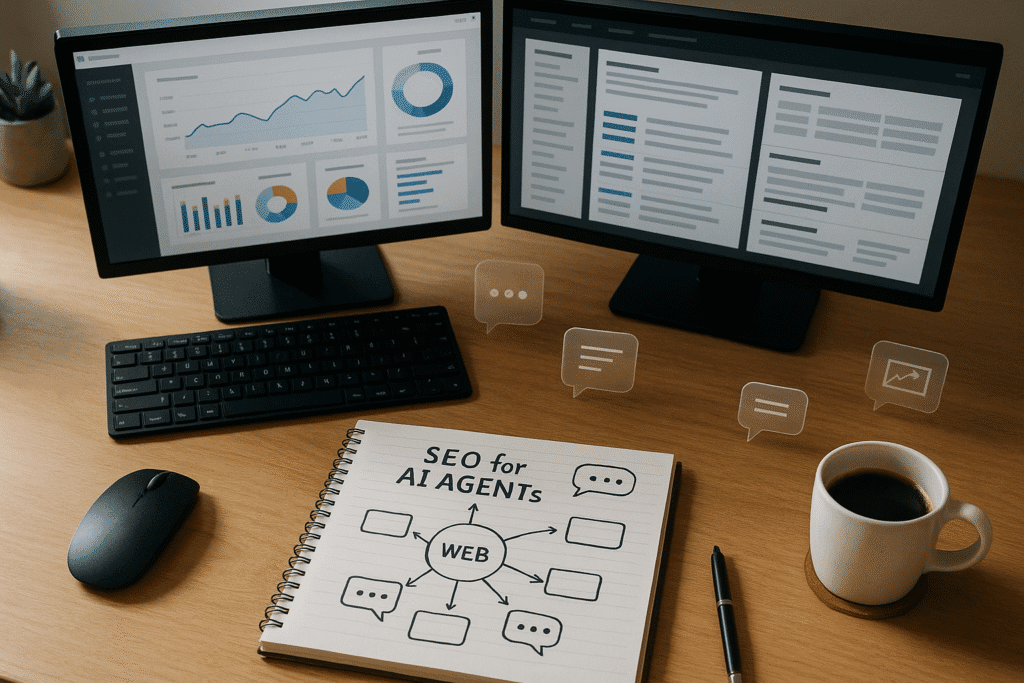
Most websites are still built on a “landing page plus blog post” model. Agents do not care about that. They care about how quickly they can answer a chain of related questions without switching sources.
In my own projects, I start content planning from conversations, not keywords. I map the primary intent, obvious follow ups, objections, and downstream actions. Then I treat each page as a mini knowledge graph that covers this whole path. Surfer’s analysis of one million SERPs shows that top pages cover a larger share of related subtopics than weaker pages, which confirms how much depth now matters for rankings.
To make that conversation machine readable, I structure sections very deliberately.
Human first, agent readable: a simple structure
Here is a structure you can adapt for almost any strategic page.
| Layer | Role for humans | Role for agents |
|---|---|---|
| Clear H1 and intro | Set context and promise | Anchor main intent and entities |
| Summary / quick answer block | Fast skim and trust check | Snippet to quote or compress |
| Thematic H2 sections | Deeper narrative and education | Answer clusters of related questions |
| Tables and checklists | Skimmable decision support | Easy data extraction and comparison |
| FAQs and objections | Handle doubts and edge cases | Ready made follow up answers |
| Internal links | Guide the journey | Signal topical depth and relationships |
The article you are reading follows the same pattern. I use this consistently for pages where I want stronger visibility for agents, because it mirrors how assistants try to assemble coherent answers across a topic.
When I audit content for agents, I score each key page across five dimensions: contextual coverage, credibility and freshness, uniqueness, factual accuracy, and clarity of structure. Pages that score high across all five tend to perform better in both search and AI surfaces. This aligns strongly with independent studies that show depth, trust, and clarity are now the dominant levers for visibility.
SEO For AI Agents And Metadata: Speaking The Right Language
If content structure is your body, metadata is your accent. It decides how clearly agents understand what you sell, who you serve, and which products or ideas they should pull into their answers.
Google’s own documentation on helpful content and structured data keeps repeating the same message. Make your information unambiguous, consistent, and aligned with how people search in real life. Google for Developers AI centric ranking studies add another layer, showing that strong technical foundations and schema help assistants trust and reuse your content more often.
A practical metadata checklist for agent friendly pages
For each strategic page, I run a quick checklist like this.
| Area | What to implement |
|---|---|
| Title and H1 | Include primary intent, not just a vanity phrase |
| Meta description | Direct answer plus curiosity, aligned with conversational queries |
| URL and breadcrumbs | Clean, descriptive, consistent with site structure |
| Schema markup | Product, FAQ, HowTo, Article, Organization where relevant |
| Entities | Clear brand, product, category, and attribute names |
| Images | Descriptive file names and alt text that match user language |
| Internal links | Connect into topical hubs for agents and humans |
Product descriptions for agents deserve special attention. When I work with ecommerce brands, I treat each product as a structured object, not just a nice paragraph. I include attributes like use case, audience, compatibility, ingredients, and constraints in a consistent format.
That makes it far easier for assistants to match products to specific user requirements and cross check them against constraints like allergies or shipping regions.
If you are building toward business to agent commerce, think of this as your preparation layer. Your documentation, taxonomy, and metadata should all support the scenarios you outline in The Complete Guide to B2A Commerce [Business to Agents]: Preparing Your Ecom Brand for the AI-First Era. When that foundation is solid, optimisation work like Optimization for B2A becomes far more effective, because the data model is already agent ready.
Ranking Signals Across Google And AI Assistants
Here is the uncomfortable part. You can structure your content perfectly and still lose if your ranking signals are weak. The good news is that the underlying physics are clearer than they were a few years ago.
FirstPageSage’s long running study of Google’s algorithm suggests that consistent publication of helpful content, keyword in meta title, backlinks, niche expertise, and searcher engagement carry the most weight in 2025. SurferSEO’s one million SERP study reinforces that speed and technical quality still correlate strongly with rankings, because they improve behavioral signals like bounce rate and engagement depth. Google’s own guidance folds this together under E-E-A-T and “helpful, reliable, people first content”.
AI assistants simply borrow many of these signals and remix them with platform specific logic. Recent analyses show that online reputation, authority, and strong SEO foundations are critical inputs across ChatGPT, Gemini, Perplexity, and other systems.
A simple cross platform ranking view
You do not need every detail of every model. You need a working hierarchy.
| Signal layer | Examples |
|---|---|
| Trust and reputation | Reviews, brand mentions, expert profiles, consistent identity |
| Content satisfaction | Depth of coverage, readability, low pogo sticking |
| Technical health | Speed, mobile UX, Core Web Vitals, HTTPS |
| Topical authority | Clusters of related content, internal links, original research |
| Metadata and structure | Titles, schema, entities, FAQs, clean site architecture |
In my own work, I translate this into a measurement stack. I combine classic SEO tools with manual reviews of AI answers. I check whether assistants pull my brand into relevant queries and whether they quote pages I actually want to rank.
This is where agent focused work overlaps heavily with general visibility for agents. If your brand appears as a trusted answer source, your ranking signals are doing their job. If you are absent, you either have a discoverability issue, a relevance issue, or a trust issue.
Measuring Agent Engagement In The Real World
Most dashboards still stop at organic traffic and rankings. That is not enough anymore. You also need to know how often assistants see you, cite you, and drive people toward you.
In recent industry writing, teams share how they log citations from ChatGPT, Perplexity, Gemini, and others, then treat those mentions as a new performance channel alongside search and social. At the same time, analysis of LLM outputs shows that platforms like Reddit and YouTube are heavily overrepresented as sources. That means your brand competes not only with classic publishers, but also with UGC ecosystems that agents already trust.
Practical metrics for agent engagement
Here is a simple measurement setup I use with growth clients.
| Area | Metric or practice |
|---|---|
| AI visibility | Manual queries in top assistants, saved screenshots, and change logs |
| Citation tracking | Spreadsheet or database of when and where your brand is cited |
| Traffic attribution | GA4 views grouped under “AI answers” or similar custom channel |
| Brand presence | Share of voice checks for key topics and competitor comparisons |
| Feedback loops | Experiments on structured content, FAQs, and product fields |
In my early experiments, the first big win often comes from tightening product data and FAQ visibility. Once agents can reliably match your products to specific intents, you start seeing more citations and higher quality traffic.
This is where Optimization for B2A becomes more operational. I treat each improvement as a hypothesis. For example, “If we add constraint fields for dietary needs into our product descriptions for agents, will AI shopping experiences match us to more long tail queries?” Then we run structured tests and watch how citations and assisted conversions shift over a few months.
Integrating Agent First SEO With Human First SEO
I do not recommend creating a separate SEO playbook “just for AI agents”. That is how teams double their workload and confuse their own strategy. Instead, I view agent first optimisation as a layer that sits on top of a solid human first SEO baseline.
Google’s guidance on E-E-A-T and helpful content is still the best description of that baseline. You need strong experience signals, subject matter expertise, clear authority, and very visible trust markers. Then you add an “agent lens” to your planning, creation, and optimisation cycles.
A combined workflow you can apply
Think of your workflow in phases.
| Phase | Human SEO focus | Agent SEO layer |
|---|---|---|
| Research | Search intent, competitive content, audience pains | Entity mapping, question graphs, platform behaviour |
| Strategy | Topic clusters, editorial calendar | Agent visibility goals, B2A roadmap |
| Creation | Helpful articles, guides, product pages | Structured sections, rich FAQs, consistent schemas |
| Optimisation | On page SEO, internal links, speed fixes | Agent testing, citation monitoring, data refinement |
| Reporting | Rankings, traffic, conversions | AI channel traffic, assistant citations, B2A signals |
Behind the scenes, I increasingly rely on a small multi agent system to support this workflow. I use research agents to scan competitors and emerging topics, strategy agents to cluster keywords into question graphs, content agents to generate initial outlines, optimisation agents to refine metadata and schema, and performance agents to monitor search and AI surfaces.
The key is that humans stay in the loop. Agents can map data faster, but judgment, brand voice, and risk management stay with you and your team. When you align this with your visibility for agents roadmap and long term B2A ambitions, you get a system that compounds instead of a set of disconnected experiments.
Q&A: Agent Friendly SEO In Practice
Q: What is seo for ai agents in simple terms?
A: It is the practice of structuring your content, metadata, and product data so that AI assistants can understand, trust, and reuse it easily. You still write for humans first, but you format information in a way that matches how agents answer questions and make recommendations.
Q: How are product descriptions for agents different from normal ones?
A: Traditional product descriptions focus on persuasion and copy. Product descriptions for agents still do that, but they also expose structured attributes like use cases, constraints, audiences, and specifications. That format makes it easier for assistants to match your products to detailed user intents.
Q: Do I need separate content just for AI assistants?
A: Usually no. In my experience it is more effective to upgrade your existing content so it is both human friendly and agent friendly. Use schema, FAQs, clear entities, and strong E-E-A-T signals. Then layer in specific projects focused on B2A journeys and agent centric product data where it matters most.
Conclusion: Build For Humans, Translate For Agents
The brands that will win in this cycle are not the ones writing the most content. They are the ones whose content is easiest for humans to trust and for agents to reuse.
If you treat seo for ai agents as an add on, you will always feel behind. If you weave it into how you plan topics, structure pages, and measure performance, your organic flywheel becomes much stronger. Start with a handful of key pages and products, use the frameworks in this article, and connect them to your broader plans for visibility for agents and Optimization for B2A.
My view is simple. We are not moving into a world where humans disappear from the funnel. We are moving into a world where agents filter more of what people see. If you design for both, you are building a marketing system that is ready for the next decade, not just the next update.
Quick Knowledge Check
Question 1: What makes content truly agent-friendly?
Question 2: How should you integrate seo for ai agents into your strategy?
