
If you’ve been following the evolution of e-commerce, you’ve likely heard terms like B2B and B2C tossed around for years. But a quiet revolution is already underway: the Business-to-Agent (B2A) model.
In this new reality, businesses no longer just market to people, they market to machines, AI agents that make buying decisions on our behalf. Understanding what B2A is, and how agentic commerce works, will define who stays visible and competitive in the next era of digital trade.
Summary / Quick Answer
Business-to-Agent (B2A) commerce describes how businesses design, structure, and optimize their digital ecosystems for consumption by AI agents instead of humans. These agents, like shopping bots, personal AI assistants, and automated procurement systems, evaluate data such as price, delivery speed, and reliability to make decisions for users.
In short:
- B2A shifts ecommerce from emotional storytelling to data transparency.
- AI agents become the primary intermediaries between brands and buyers.
- Businesses must optimize content, APIs, and data for agent readability.
- Agentic commerce transforms competition from appealing to people to persuading algorithms.
That’s the essence of what B2A is: a system where digital agents, not humans, decide which brands win attention and conversions.
The Definition and Evolution of B2A Commerce
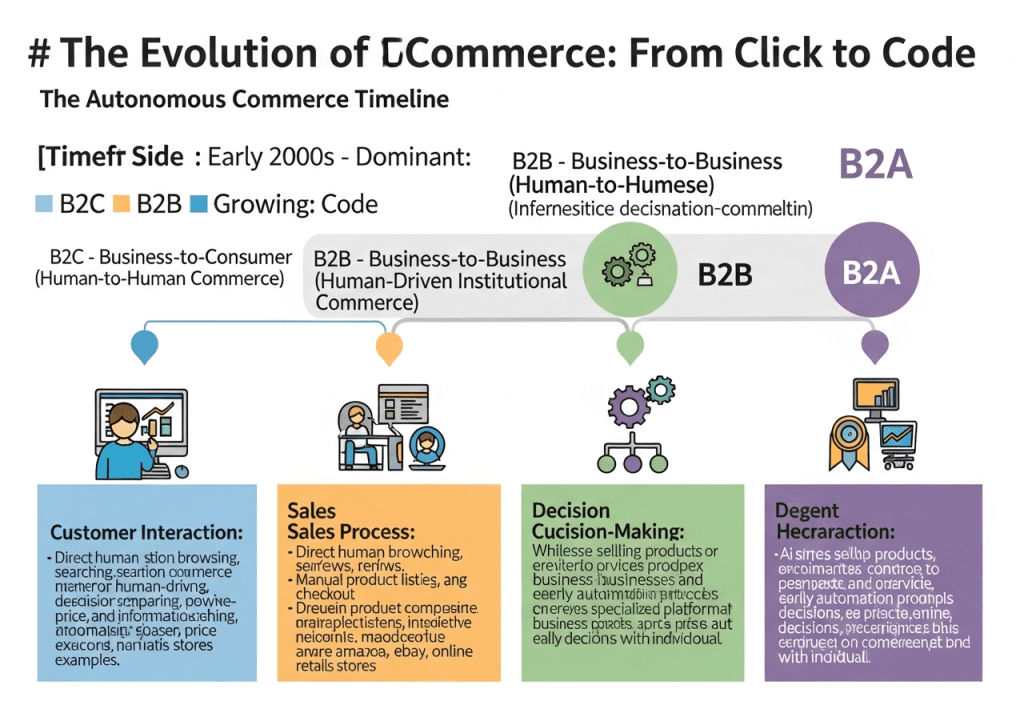
Most business models were built for human buyers. B2B thrives on negotiation and contracts. B2C relies on emotional storytelling and design. But B2A flips that logic entirely. It’s about making your business understandable to machines.
In B2A commerce, brands design digital assets: APIs, feeds, metadata, and structured content for AI agents to analyze and act upon. These agents interpret inventory levels, delivery options, prices, and even sustainability metrics to make instant, autonomous choices.
The roots of this shift go deep into the rise of agentic AI, systems with increasing autonomy to execute decisions. According to Kantar’s retail study, agents are already driving purchase decisions in categories like travel, media subscriptions, and everyday retail. As these agents gain trust and intelligence, businesses must transition from selling to people to communicating effectively with algorithms.
I’ve seen this evolution firsthand while optimizing digital ecosystems for automation. What used to be “SEO for people” is becoming SEO for AI. You’re not just convincing a visitor anymore, you’re convincing a digital gatekeeper that your product best fits the data-driven intent of its user.
Comparing B2A with B2B and B2C
Here’s where it gets interesting. The logic behind B2A isn’t entirely new; it builds upon what we already know, but the buyer has changed.
| Model | Primary Counterparty | Decision Logic | Interaction Focus | Example |
|---|---|---|---|---|
| B2B | Other businesses | Human-led, negotiated | Relationship, contracts | Manufacturer selling to distributor |
| B2C | Consumers | Emotional, experiential | Storytelling, personalization | Online store marketing to shopper |
| B2A | AI agents | Data-driven, autonomous | APIs, structured data, optimization | Brand optimized for AI shopping bots |
While B2B and B2C depend on emotional or relational leverage, B2A is machine-to-machine communication. The emotional appeal that drives human conversion loses relevance when your audience is an algorithm.
If you think about platforms like Google Shopping or Amazon’s recommendation engine, they’re already functioning as proto-agents—systems that decide which product to show before the user even asks. That’s agentic commerce in its early form.
Businesses now need to think less about “marketing to audiences” and more about training AI agents to understand their offerings. This is where Optimization for B2A becomes a critical strategy. It’s not about content for clicks, it’s about content for comprehension.
Why B2A Is Becoming Central to E-commerce
AI is no longer just a tool for analytics or ad targeting. It’s becoming the buyer. And that changes everything.
We’re already witnessing a surge in agent-driven transactions: flight rebookings handled by travel bots, household restocking automated through voice assistants, B2B sourcing optimized by procurement AIs.
According to Stripe’s agent-ready commerce guide, up to 40% of routine digital purchases could soon be completed by autonomous agents.
For businesses, this introduces both opportunity and pressure. If your data isn’t clean, accessible, or machine-readable, agents will skip over your offer entirely.
That’s why leading brands are investing in structured product feeds, transparent pricing APIs, and real-time availability updates.
In my view, the shift to B2A will do to ecommerce what mobile responsiveness did a decade ago. Those who adapt early will thrive.
Those who don’t will simply disappear from algorithmic visibility.
And here’s the kicker: it’s not just ecommerce. Financial services, logistics, healthcare, and any sector with repetitive data-driven decisions will soon depend on agentic commerce frameworks.
Designing for AI Agents: The New Digital Playbook
Let’s talk about what it actually takes to operate in a B2A world. Optimizing for AI agents means creating systems that are:
- Structured: data must be consistent, well-labeled, and API-accessible.
- Transparent: agents reward clarity in pricing, stock, and delivery speed.
- Updatable: decisions happen in milliseconds, so stale data costs visibility.
- Interoperable: your product info should be readable across multiple ecosystems (Google, ChatGPT, Alexa, Shopify bots).
In essence, every business now needs to speak machine. That’s where strategies like How AI Agents Shop come into play. These agents don’t browse pages; they analyze schemas. They don’t feel emotion; they evaluate logic.
I’ve worked with ecommerce teams who still measure success by engagement metrics like time on page. In the B2A era, that’s a relic.
The new metrics are machine trust, API performance, and data clarity. Think of it as building loyalty with algorithms rather than humans.
The New Competition: Persuading Algorithms
Here’s a mental shift worth embracing. In traditional marketing, persuasion is emotional. In B2A, persuasion is mathematical.
If your brand data is more complete, structured, and verifiable than your competitors’, AI agents will prefer you. The result? Higher visibility across agent-driven recommendations.
That’s the new marketing frontier. Winning no longer depends on creative flair alone it depends on technical fluency and trust signals optimized for autonomous systems.
The Future of Agentic Commerce
Looking ahead, I believe B2A will merge naturally into A2A (Agent-to-Agent) ecosystems, where business and consumer agents transact directly without human involvement. Imagine your inventory management AI negotiating with a client’s procurement bot, agreeing on terms, and executing payment within seconds.
This isn’t speculation. Platforms like Thoughtworks’ agentic commerce framework are already designing infrastructure for it. The trajectory is clear: humans will set strategy, AI agents will execute.
The big question is whether your business will be agent-readable by the time this becomes the default mode of commerce.
I’d summarize it this way: in the past decade, we optimized for screens. In the next one, we’ll optimize for agents. And that’s where the real strategic leverage lies.
Q&A
Q: What is B2A in simple terms?
A: It’s when businesses design digital systems that interact directly with AI agents instead of human users. These agents analyze data and make autonomous purchasing decisions.
Q: How is B2A different from B2B or B2C?
A: B2B and B2C involve human decision-makers. B2A targets AI agents as intermediaries, requiring structured data and machine-optimized ecosystems instead of emotional marketing.
Q: Why should businesses care about agentic commerce?
A: Because AI agents are already influencing which brands users see and buy from. Optimizing for them ensures continued visibility and competitiveness in automated markets.
Conclusion
The Business-to-Agent (B2A) model isn’t a futuristic idea, it’s the natural evolution of how commerce adapts to automation. As AI agents gain purchasing power, the rules of visibility, persuasion, and conversion are being rewritten.
For marketers and founders, this is the moment to rethink your strategy. Audit your data. Rebuild your APIs. And start preparing your brand for algorithmic customers who never sleep, never scroll, and always optimize.
If you’re curious about how to get there, start with Optimization for B2A or explore How AI Agents Shop. These shifts aren’t optional; they’re inevitable.
We’re entering a world where marketing becomes a dialogue between humans and machines. The brands that learn to speak both languages will lead.
